
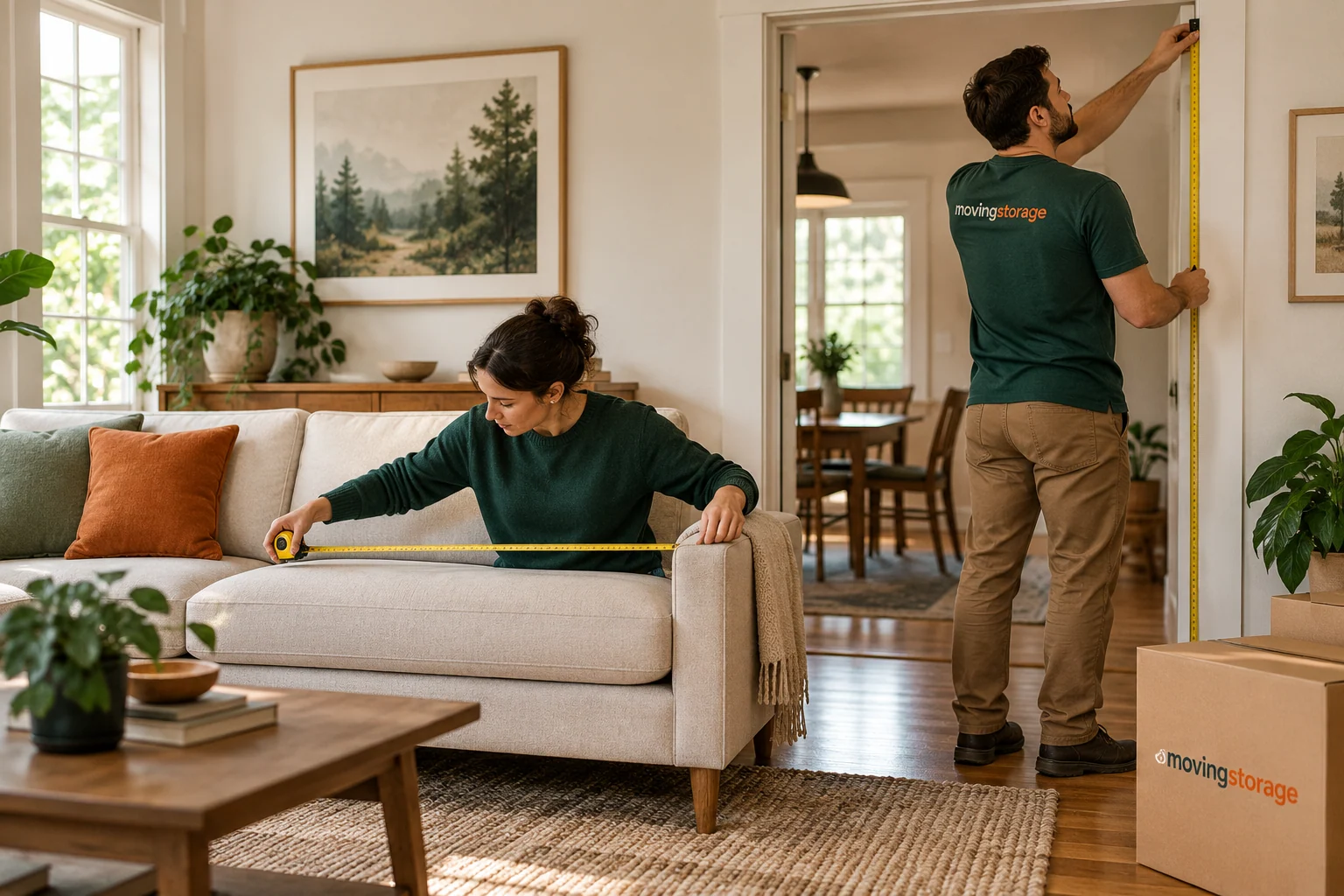
Check whether large furniture will fit by measuring the item and the entire route it must travel. The front door is one checkpoint. A tight turn, low ceiling, stair landing, or interior doorway may set the real limit. Complete the check before collection so you have time to obtain an assessment and choose an alternative if needed.
Use measurements to give the moving company useful information. They do not turn a difficult move into a safe do-it-yourself job. The item's weight, construction, condition, available equipment, and handling method also matter. Ask qualified movers to assess an uncertain route rather than trying a forceful test with an awkward piece.
Identify the pieces that need attention
Begin with sofas, wardrobes, tables, beds, cabinets, appliances, and any unusually long, wide, heavy, or fragile object. Include furniture that reached the current room in parts but is now assembled. An item that came through a doorway years ago may have arrived before a new door frame, stair rail, or built-in cupboard changed the route.
Make a short list with a photograph and an inventory reference for each piece. Note whether it has removable legs, leaves, shelves, doors, or other components according to the manufacturer's instructions. Record anything you already know about fragile joints, repairs, loose parts, or an unusual mechanism. These details affect the assessment and preparation.
Check the destination room before focusing only on the journey through the building. A table might pass the entrance yet leave too little room to use the chairs. A wardrobe might fit the wall but prevent a door opening. Mark the intended position on a simple room plan and allow for the normal use of the room.
Measure the furniture as it will travel
Record maximum height, width, and depth, including protruding arms, handles, feet, and fixed trim. Use a consistent unit of measurement and label each dimension clearly. Do not copy only a product name or nominal size from an old order. The assembled item in your home may differ from the version described online.
If parts can be removed appropriately, record both the assembled measurements and the measurements of the main pieces after the approved preparation. Make clear which figure describes which state. Ask the mover whether it wants measurements before or after protective packing, and allow the company to assess the extra space required by its handling method.
Photograph the measuring points so another person can understand your record. A picture of a tape across the widest arm of a sofa explains more than a loose number in a message. Do not climb onto unstable furniture or attempt to move a heavy piece just to obtain a hidden measurement. Ask for help or leave that part of the assessment to the mover.
Map the route from the item outward
Start at the current position and follow the route to the loading point. List the room doorway, corridor, corners, steps, stairs, landings, shared doors, and outdoor path in order. Note where the crew would need to change direction or level. A sequence is easier to assess than a collection of unrelated doorway measurements.
Look for fixed projections such as radiators, light fittings, handrails, built-in cupboards, and door closers. Note them on the route rather than assuming a mover can lift over or around them. Mention narrow areas outside the home too, including gates, garden turns, and ramps. They may matter even when the indoor route is generous.
Repeat the map at the destination, starting at the approved unloading point and ending at the chosen room. Do not assume that a successful pickup proves the delivery route will work. If the destination is unavailable for a visit, ask the owner, agent, or building manager for current information and arrange an assessment where the uncertainty remains significant.
Record usable openings
Measure the clear opening available when a door is in the position permitted for moving. Frame dimensions or a door's advertised size may not describe the usable gap. Record projections, a door that does not open fully, and the available space on both sides. Ask the mover which additional details it needs.
Check whether the approach allows the item to line up with the opening. A wide doorway at the end of a very narrow corridor can still be difficult. Measure the corridor and the space immediately before and after the door. Include photographs from both directions so the company sees how the openings connect.
Do not remove a door, closer, handrail, window, or other fixed feature without the required permission and appropriate help. Some changes affect building safety or require a specialist. Ask the property manager and moving company how an authorized adjustment would be handled, who would do it, and who would reinstate the feature afterward.
Give stairs and landings their own check
Record stair width, turns, landing dimensions, headroom, and any fixed rail or ceiling projection. Photograph the top and bottom approaches as well as the steps. The space needed to turn a long item can be different from the space needed to carry a small carton straight up.
Ask whether the item has been moved along the route before and what method was used, but treat that history as background rather than a guarantee. The furniture, building, or available equipment may have changed. Tell the mover about known difficulties without telling it to copy an old handling method that you cannot assess.
Avoid trial runs with a heavy object on the stairs. A piece can become stuck in a position that is difficult to reverse, while blocking access and creating a risk to people. If measurements suggest a close fit, arrange the mover's assessment before the collection booking becomes final.
Check lifts through the building's information
Ask the building manager for the relevant lift dimensions, clear door opening, operating rules, and capacity information. Give the moving company the information supplied by the building. Do not infer capacity from the size of the cabin or from the fact that people use the lift every day.
Check the route into and out of the lift. The lobby or turn outside may be more restrictive than the cabin. Ask about service-lift bookings, protective materials, staff operation, and time slots. Confirm whether the planned move can use that lift and whether particular items need another approved route.
Include a backup question: what is the plan if the lift is unavailable? This may change the service or make a different date necessary. Ask the company and manager to resolve the practical options. Do not assume that the crew can simply use stairs for a piece whose stair route has not been assessed.
Distinguish dismantling from taking a risk
Find the manufacturer's instructions or an appropriate specialist's advice for furniture designed to come apart. Ask the moving company which dismantling tasks are included and which need separate preparation. Record the agreed responsibility in the service scope so the day does not begin with two parties expecting the other to have done the work.
Keep components and hardware linked to the item. Label small bags with an inventory reference and retain a copy of the instructions. Photograph the arrangement before taking apart approved components where that will help reassembly. Avoid loose screws in a drawer that may be emptied or separated from the furniture.
Do not break glued joints, alter structural parts, disconnect powered furniture, or modify an appliance to make a gap work. Specialist pieces need an appropriate assessment. A lower measurement after an improvised alteration does not establish that the furniture remains safe, usable, or covered by the service you arranged.
Consider the load and handling equipment
Tell the mover about weight information you have from the manufacturer, especially for solid furniture, stone surfaces, safes, and powered equipment. If you do not know the weight, say so. Let the company decide whether it needs further information or a site visit rather than estimating a heavy item's weight from its appearance.
Ask whether the approved route suits the equipment the crew plans to use. Steps, sharp turns, soft ground, or a narrow gate may affect that decision. Give the company photographs and surface details. Do not buy handling equipment on the assumption that any trolley will solve an access problem.
The parking and loading access guide helps connect the building route to the vehicle. The last stretch matters too: a long carry from a restricted loading point can change the work involved. Send the route and parking information together so the company can assess the complete job.
Ask for a decision while alternatives remain open
Send a compact record with the item code, photographs, measurements, route map, and questions. Highlight uncertainty instead of burying it in several messages. Ask the mover whether the information is enough to assess the piece or whether a site visit or specialist review is needed.
Ask how the company will record a plan that depends on dismantling, a particular entrance, or another approved method. Confirm any additional service and its cost in writing. Do not rely on a general reassurance that movers deal with large things. You need an answer about your item and your route.
If the piece cannot reach the intended room, consider another room, an appropriate replacement, temporary storage, or another approved arrangement. Compare the full consequences before choosing. Moving an item to the address without a place it can actually go may create another collection and another access problem.
Use the plan on moving day
Show the assessed items to the crew leader during the opening walkthrough. Identify the approved route and any preparation already completed. Make the measurements and instructions available, but allow the crew to reassess if the actual conditions differ. A new obstruction or changed building rule is a reason to pause and review.
Keep other belongings clear of the difficult route. Do not stack cartons on a landing or leave dismantled parts where they block the approach. Put hardware and instructions in the place agreed with the company. Tell household members which route needs to stay available while the large pieces are handled.
Use the guide to preparing furniture for a move for the separate packing and condition tasks. Route planning and furniture preparation support each other, but one does not replace the other. A well-wrapped piece still needs a workable path, and a generous path still requires suitable handling.
Check the final position before the crew leaves
At delivery, identify the destination room using the same name as the route plan and inventory. Confirm the intended position before the item blocks the doorway or prevents another piece from entering. Ask about included reassembly and check that labelled components are present.
Inspect the furniture and note concerns through the provider's stated process. Do not attempt to correct a damaged structural part yourself in the middle of the delivery. Keep photographs, item references, and the relevant service documents together if further discussion is needed.
File the measurements once the move is complete. They can be useful for a future move, a room change, or a replacement purchase. Update them if the furniture or building changes. The value of the exercise is a route-specific decision made before moving day, while you still have time to select a practical and properly assessed plan.
Compare two plausible routes without forcing a choice
A dining table might have a direct route through a narrow front hall and a longer route through a wider rear entrance. Record both routes for the mover, including their restrictions and the table's approved dismantled dimensions. Do not select the shorter route simply because the distance looks easier. The company needs to consider the turns, surfaces, access permission, and handling method as a complete assessment.
For a sofa, compare its widest fixed points with the sequence of openings, not a single doorway. Note where a turn would be required and what surrounds that turn. Avoid interpreting a small numerical difference as proof that a piece can be angled through. Measurements can identify a question for the mover; they cannot by themselves establish how a heavy or fragile object should be manipulated.
If a previous delivery used a window or another unusual opening, tell the company, but ask for a fresh assessment. The method may have depended on equipment, permission, or conditions that are no longer available. Do not arrange an improvised repeat with household helpers. A special route should be part of a properly authorized plan with the appropriate specialists.
Keep an alternative destination for the piece in mind while the assessment is underway. If the intended upstairs room is unsuitable, a ground-floor room may or may not be acceptable to you. Decide that before delivery rather than allowing the item to be placed in the first available space. The room plan should reflect a real decision about use, access, and future movement.