
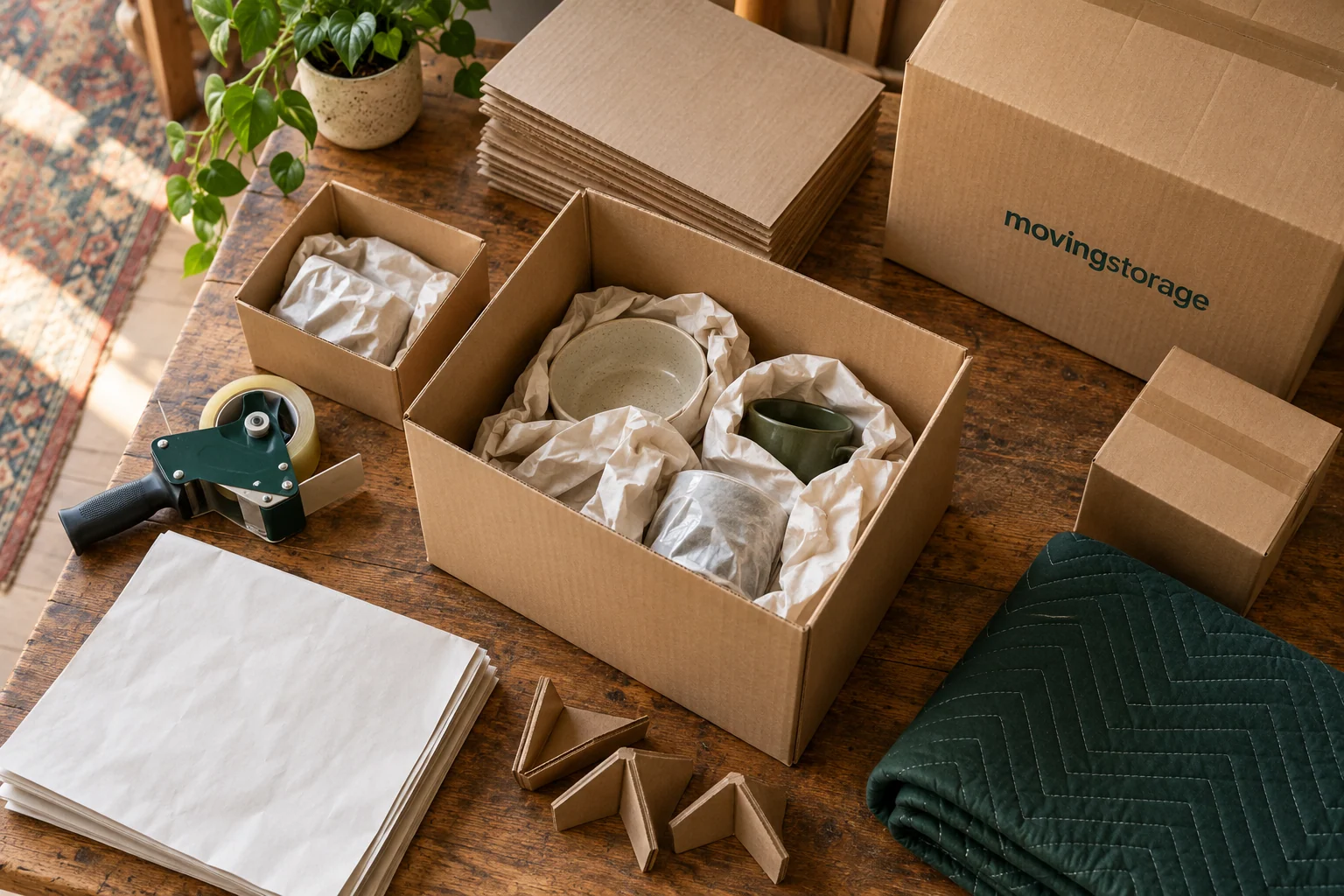
Buy packing supplies after you look at the belongings they need to protect. A stack of boxes can seem like progress, but the wrong sizes, weak bottoms, or missing protection can create more work when packing begins. Start by deciding what will travel, how it will be handled, and whether it will go directly into a home or spend time in storage.
Walk through each room with a notebook. Separate ordinary boxed items from furniture, awkward shapes, and pieces that need specialist advice. Record the things you already have useful containers for. Suitcases may suit clothing, for example, while an original fitted carton may be worth keeping for a particular device. Do not assume every existing container is strong enough for repeated lifting or stacking.
Start with a small working set
Get enough materials to pack a representative part of your home before buying everything. Choose one shelf of books, a kitchen drawer, and a group of light household items. Pack them as you expect to pack the rest. You will learn more from handling these first boxes than from estimating how many objects are visible in a room.
That trial should answer practical questions. Does the tape hold to the cardboard you chose? Can you close the box without forcing the flaps? Does the packed box remain manageable to lift? Is there room to label a side after the tape is in place? Keep notes on the supplies actually used, then scale up according to the remaining inventory rather than repeating a supplier's room-count bundle.
A working set also reduces waste. You may discover that several large cartons would be poor choices for dense belongings, or that the packing paper you bought is suitable for some items but not a delicate finish. Keep unused materials clean and dry, retain receipts, and check return terms before buying more than you can reasonably use.
Choose boxes by weight and shape
Smaller boxes help limit the amount of dense material that can fit in one container. They are often more useful for books, files, and similar belongings than a large carton that looks efficient while empty. The correct limit depends on the box, its condition, the contents, and the handling arrangements. Follow the manufacturer's stated limits and your mover's requirements instead of relying on a universal box weight.
Larger cartons can be useful for light items, but they still need enough structure to remain stable. A large box of loose bedding may handle differently from the same box compressed tightly around hard objects. Check that the contents fit, then consider how the carton will be carried through a doorway and placed in a vehicle. A carton that bulges or cannot close normally needs repacking.
Check reused boxes carefully. Look for softened corners, torn handholds, crushed edges, old water marks, and weakened seams. Remove or cover irrelevant labels so the destination is clear. Do not use a food container that carries residue, odor, or signs of pests. A free box that fails partway through the move can cost more time than a suitable replacement.
Specialty cartons deserve a separate decision. Wardrobe boxes, picture cartons, and divided dish cartons solve different problems. Ask how each is intended to be assembled and used. Confirm whether your mover supplies or rents them, who packs them, and whether the material is included in the estimate. Avoid paying twice for supplies already covered by your chosen service.
Separate cushioning from surface protection
Packing materials perform different jobs. Some help prevent rubbing against a finish; others help keep an object from moving within a container. A soft layer around a fragile piece does not automatically make a loosely packed box stable. You need to consider the surface, the shape, the space around it, and the way the carton may be handled together.
For an ordinary household item, begin with a clean, compatible surface layer and a box that leaves sensible room for protection. Fill gaps without forcing pressure onto delicate handles, edges, or projections. Close the carton and assess whether the contents can shift before sealing it. Do not shake a fragile object aggressively as a test. If you cannot judge its protection confidently, ask the provider to assess it.
Newsprint, recycled paper, foam, bubble material, and fabric covers are not interchangeable for every finish. Ink, dirt, trapped moisture, or direct contact with an unsuitable material may matter for particular objects. Read the product instructions and the item's care information. With valuable artwork, unusual coatings, or unstable materials, get item-specific advice rather than improvising a protective layer from whatever is nearby.
For books that will remain packed for a prolonged period, the Library of Congress book-packing guidance recommends considering acid- and lignin-free storage boxes. That is a more specific material description than a vague promise on a package. Different collections may need different enclosures, so distinguish ordinary moving cartons from materials chosen for long-term preservation.
Make tape and closures part of the plan
Choose tape intended for the boxes and conditions in which you will use it. Read its application instructions, including any temperature or surface requirements. A carton assembled correctly on a clean, dry work surface is a different proposition from one sealed in a dusty garage while the tape is already peeling away. Follow the box maker's assembly instructions and inspect the bottom before adding belongings.
Do not use extra tape to disguise a damaged carton or force a poorly fitting lid into place. Tape can close a suitable box; it cannot restore every weakened panel or make an overloaded container safe. If flaps are pulled apart by the contents, repack the item or choose a different container. Leave lifting areas clear and avoid creating loose strips that may catch during handling.
Keep sharp cutting tools controlled while you work. Use them away from the item and store them safely when you leave the packing station. At the new home, open cartons carefully because the contents may be immediately under the top flaps. Make it easy to find an appropriate opener without putting an unprotected blade into an essentials bag.
Use covers that match the furniture
A mattress cover, furniture blanket, and stretch film each serve a different purpose. Ask your provider which materials are appropriate for the particular item and whether they are intended only for transport or also for storage. A wrap that helps contain a moving blanket is not automatically a suitable long-term cover for every upholstery or wood finish.
Before covering a piece, remove loose dirt in a way consistent with its care instructions and let any cleaned surfaces dry fully. Do not pack a damp item in the hope that it will finish drying inside the cover. Check the underside and removable components too. If there is existing damage, photograph it before the protective materials make it harder to see.
Give vulnerable corners, legs, and detached parts their own attention. A large blanket across the top does little for a loose shelf or a small fitting placed at the bottom of an unmarked carton. Keep hardware in a secure labelled container and note which piece it belongs to. If disassembly requires technical knowledge, arrange that work rather than treating a roll of wrap as the solution.
Buy labels that support the whole move
Use a marker that remains readable on the carton surface you selected. Choose a simple identifier, a destination room, and a short description for each box. Label a visible side as well as the top, because stacked cartons often hide top labels. If you use colored labels, include words or numbers too so the system does not depend entirely on recognizing a color.
Keep one consistent method from the first box onward. The box labeling guide explains how identifiers and destination names can work together. Set aside enough labels and markers for late packing, including the final packing session. Kitchens, cleaning supplies, and the final cupboard contents often need attention after most packing materials have been put away.
A separate label for items staying with you can prevent confusion during pickup. Make that distinction obvious and physically separate the items where possible. A small sticker alone may be missed among dozens of cartons. Explain the arrangement to everyone helping, and keep the labels private enough that they do not advertise valuables or personal information to passersby.
Consider storage and the unpacking end
If a carton will enter storage, think about its likely duration and how often you will need to open it. Repeated access can wear closures and make labels harder to follow. Reusable containers may suit some items, but confirm that their dimensions, handles, lids, and stacking arrangements are appropriate. Never assume a container's ability to exclude splashes means it controls the surrounding temperature or moisture.
Plan disposal and reuse before buying a mixed pile of materials. Separate clean paper and flattened cartons from materials your local collection service handles differently. Keep any reusable protective covers with their instructions. A simpler selection of supplies can be easier to sort at the other end, especially when you are unpacking in a building with limited waste storage.
It helps to decide which rooms will be packed first, because those rooms can act as your trial for both supplies and method. Follow a room-by-room packing plan and note where actual consumption differs from your first estimate. Adjust as you go. There is no benefit in protecting the least-used room elaborately while leaving the everyday kitchen without suitable cartons.
Make the final purchase from a written list
Before ordering the remaining supplies, write down the box sizes and quantities you have actually tested, the special items still unresolved, and the materials your provider will bring. Separate essential purchases from optional conveniences. Include an allowance for labels, tape, and the few cartons you may need on the last morning, but avoid buying an arbitrary reserve of every product.
Check delivery timing and where the materials can be stored without blocking daily life. Flat-packed boxes still occupy space, and protective paper can become unusable if left somewhere damp. Keep children and pets away from loose wrapping, tools, and packing debris. A clear, workable packing station is part of using the materials well, not a task to postpone until the house is already full of cartons.
At each stage, use the supply that solves the actual handling problem. The aim is to contain the item, protect compatible surfaces, limit movement, and make the destination clear. When an object falls outside your experience, ask for help before wrapping it. That decision is often more useful than adding another layer of material whose purpose you cannot explain.
Check the work area before buying equipment
Your packing space affects which supplies are convenient to use. A large dispenser, an oversized carton, or a long sheet of protective material may be awkward on a narrow table. Set up a clean, well-lit surface with room for the item and its open container. Keep the materials within reach without covering the floor route. If you are sharing the home during packing, choose a station that can be made safe at the end of each session.
Try the tools with the people who will use them. A tape dispenser may be comfortable for one person and difficult for another. A marker label may need larger lettering to remain readable for a household member. Plan around actual handling ability, not an assumed standard packer. If a carton cannot be managed comfortably after it is filled, change the contents or arrange appropriate assistance instead of treating the problem as a failure of effort.
Keep a small repair and replacement stock separate from the main supply pile. This can include a suitable spare carton, spare labels, and the tape needed to close something that was opened for a final check. Mark that stock so it is not used up during the first packing sessions. Its purpose is to handle ordinary changes, such as discovering that one box is damaged or that a necessary item was packed too early.
Ask who owns supplied materials after the move
If a provider brings blankets, crates, wardrobe boxes, or other reusable equipment, confirm whether those materials are rented, loaned, or included for you to keep. Ask when they must be returned and who arranges collection. Do not make a long-term storage plan around a cover that the moving crew expects to remove at delivery. Put the arrangement in your moving notes so another household member does not discard or repurpose something that needs to go back.
Make the same check for materials used during packing services. Ask whether the service includes taking away empty cartons or whether disposal remains your responsibility. If collection is offered, find out how the cartons should be stored and when they must be ready. Knowing the end of the material's journey can influence what you buy, where you place it while unpacking, and how much temporary room you need in the new property.
Compare purchases using the same quantities and intended uses. A bundle with more large boxes is not automatically more useful than one with fewer cartons in sizes that suit your load. Record the total delivered price and any return conditions, then choose from the trial you have already packed. The best supply list is one you can explain item by item, with a specific job for each material and a clear plan for what remains unused.